
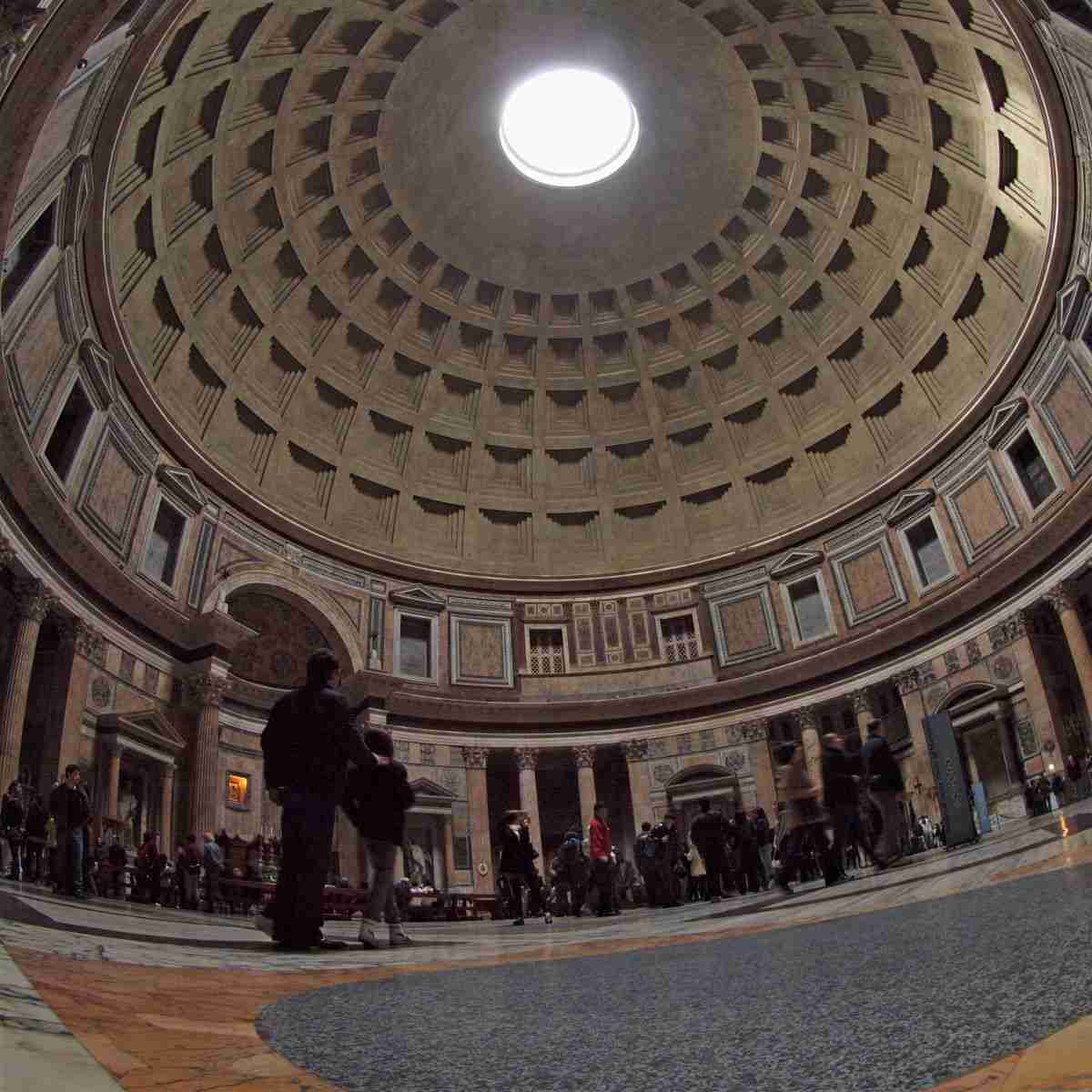
The Pantheon is one of the best-preserved buildings from ancient Rome. Almost 2,000 years after its construction, you can still walk through its enormous bronze doors. You can still stand beneath its Roman concrete dome.
The building is remarkable for one main reason. Its interior survives as a complete architectural space. The circular rotunda, colored marble, massive dome, and open oculus above you let you experience Roman architecture from the inside. You’re not just looking at ruins from a distance.
If you’re planning to visit the Pantheon in Rome, know this first: it’s also an active Catholic church. Officially, it’s the Basilica of Santa Maria ad Martyres. It contains the tombs of the artist Raphael and two kings of unified Italy.
Plan Your Visit to the Pantheon
| Address | Piazza della Rotonda, Rome |
| Opening hours | Daily, 9:00 AM–7:00 PM |
| Last admission | 6:30 PM for individual visitors |
| Closed | December 25 and January 1 |
| Standard ticket | €7 |
| Reduced ticket | €3 for eligible EU citizens aged 18–25 |
| Under 18 | Free |
| Time to allow | About 30–45 minutes |
| Nearest Metro | No Metro station immediately nearby |
| Booking | Tickets available online or on site |
| Accessibility | Accessible |
| Religious site | Yes — appropriate dress and behavior are required |
| Official website | Pantheon – Direzione Musei nazionali della città di Roma |
Important: The Pantheon is both a monument and an active basilica. Visiting hours can change for Masses and other religious celebrations.
There is no official skip-the-line ticket. Buy official tickets through Musei Italiani or at the Pantheon itself.
Why Visit the Pantheon?
The Pantheon offers something unusual. You get to stand inside a monumental Roman building that still keeps the basic form of its ancient interior.
Walk through the portico. Pass through the huge bronze doors. The space changes completely.
You enter a circular room covered by an enormous concrete dome. At its center is the oculus — a circular opening to the sky. It provides the building’s main source of natural light.
The dimensions are fundamental to the architecture. The height from the floor to the top of the dome is almost equal to the diameter of the rotunda. The result is an interior built around a remarkably balanced geometric shape.
I recommend visiting the Pantheon if:
- You want to experience ancient Roman architecture from inside a surviving building.
- You’re interested in Roman engineering and construction.
- You want to see the Pantheon’s dome and oculus.
- You’re interested in how ancient Roman buildings changed over the centuries.
- You want to see Raphael’s tomb.
- You’re interested in the history of modern Italy and its royal family.
The Pantheon doesn’t require a long visit. But give yourself enough time to stop in the center of the rotunda and simply look around, rather than just walking through it.
What Will You See at the Pantheon?
The Pantheon is, above all, an architectural experience.
There are important tombs, artworks, altars, and chapels inside. But start with the building itself.
Look at how the portico, rotunda, dome, oculus, marble floor, walls, and niches all work together.
The Portico
Your visit begins before you even enter.
The Pantheon’s monumental portico faces Piazza della Rotonda. Its granite columns support the triangular pediment above. Together, they form the building’s grand entrance.
Above the columns is one of the Pantheon’s most recognizable features: an inscription tied to Marcus Agrippa. It reads:
M·AGRIPPA·L·F·COS·TERTIVM·FECIT
Agrippa built an earlier Pantheon on this site during the reign of Augustus. The building you see today, though, mostly dates from a later reconstruction during the Roman imperial period.
The Bronze Doors
The enormous bronze doors mark the shift from the rectangular portico into the circular interior.
Their scale hints at what’s coming. But the rotunda itself stays largely hidden until you actually pass through them. That moment of transition is part of the experience.
Once inside, stop for a moment before you start moving around. Look upward first.
The Rotunda
The main interior is a vast circular space called the rotunda.
Its proportions are remarkably precise. The diameter is about 43 meters. The distance from the floor to the top of the dome is roughly the same. You could imagine a perfect sphere fitting inside this space.
The walls are decorated with colored marble, columns, niches, and chapels — elements added across the building’s long history.
But the dome is what dominates the space.
The Dome
The Pantheon’s dome ranks among the great achievements of Roman engineering.
It spans the entire rotunda with no internal columns holding it up.
Roman builders reduced the weight of the structure as it rises. The dome grows thinner toward the top. The concrete itself gets lighter as you go higher, too. The geometric coffers you see across the interior aren’t just decorative — they also reduce weight, while giving the huge surface a strong visual structure.
At the very center sits the oculus.
The Oculus
The oculus is the circular opening at the top of the dome. It’s about 9 meters across and completely open to the sky. There’s no glass.
Sunlight moves across the interior as the sun’s position changes through the day. So the oculus isn’t just a light source — it actively changes how the interior looks, hour by hour.
And yes, rain comes through it too.
The floor was designed with this in mind. A slight gradient and drainage holes handle the water.
When you visit, try to stand somewhere you can see the full circle of the oculus. Don’t just glimpse it while walking around the edge of the rotunda.
Raphael’s Tomb
The Renaissance artist Raphael is buried inside the Pantheon.
Raphael died in Rome in 1520, at just 37 years old. He’d requested burial here.
His tomb sits in one of the niches around the rotunda, marked by an inscription. It links this ancient building to another major chapter in Rome’s cultural history.
The Tombs of the Kings of Italy
The Pantheon also became a burial place for Italy’s royal family after unification.
Vittorio Emanuele II, the first king of unified Italy, is buried here. So is his son and successor, Umberto I, along with Queen Margherita.
These tombs add yet another historical layer. They connect an ancient Roman monument and Christian basilica to the birth of the modern Italian state.
From Roman Temple to Christian Basilica
The building you see today mainly dates from the reign of Emperor Hadrian, in the second century AD. An earlier Pantheon had stood on this site, built by Marcus Agrippa.
Historians still debate exactly how the Roman Pantheon functioned, and which deities were worshipped there. What’s clear is that the building survived transformations that destroyed or radically altered many other ancient structures.
A turning point came in AD 609. The Byzantine emperor Phocas gave the building to Pope Boniface IV. The Pope consecrated it as a Christian church, dedicated to Santa Maria ad Martyres.
That continuous religious use is likely what helped preserve the building.
The Pantheon is still a working Catholic basilica today. Its story didn’t end with ancient Rome — it has stayed in active use for centuries, and it still serves a religious function now.
How Long Should You Spend at the Pantheon?
For most visitors, 30–45 minutes is enough for the Pantheon itself.
That’s enough time to study the architecture, look closely at the dome and oculus, walk around the rotunda, and see the main tombs and chapels.
You can move faster if you want. But I wouldn’t treat the Pantheon as a quick photo stop — walk in, snap the dome, walk out.
The building rewards a slower pace. Look at the marble floor. Notice the different materials in the walls. Study the coffering of the dome. Watch how the light from the oculus shifts the interior as time passes.
Pantheon Opening Hours
The Pantheon is normally open:
- Monday–Sunday: 9:00 AM–7:00 PM
- Last individual admission: 6:30 PM
- Last admission for groups and schools: 6:00 PM
- Ticket office closes: 6:00 PM
- Closed: December 25 and January 1
Hours can change for religious celebrations. Ticket sales stop one hour before liturgical activities begin.
Because the Pantheon is still an active basilica, always check the current schedule if your visit falls on a major Catholic celebration.
Pantheon Tickets
Standard admission is €7.
- Standard ticket: €7
- Reduced ticket: €3 for eligible EU citizens aged 18–25
- Under 18: Free
The Pantheon isn’t included in the Roma Pass or Omnia Card.
Admission is free on designated state-museum free days, including the first Sunday of each month. During Mass, entry is also free — but only for people attending the service, not for tourist visits.
Where Should You Buy Pantheon Tickets?
Buy your tickets through the official Musei Italiani system, or directly at the Pantheon.
Official tickets are available:
- Through the Musei Italiani website
- Through the Musei Italiani app
- At the on-site ticket offices
- From the automatic ticket machines at the Pantheon
There is no official skip-the-line option.
Be careful when searching online. Commercial resellers sometimes advertise Pantheon tickets, tours, or “priority” services at prices well above the real admission fee. For a standard visit, stick with the official ticketing system.
Do You Need to Book the Pantheon in Advance?
You can, but you don’t have to. Tickets are also sold on site, at the Pantheon.
The official visiting calendar runs monthly. New tickets are typically released around the middle of the preceding month.
If you book online, stick to the time slot you selected.
Booking ahead makes sense if you already know exactly when you want to visit. If you’d rather keep your schedule flexible, on-site tickets remain available. Either way, there’s no official skip-the-line admission.
Remember: The Pantheon Is a Church
The Pantheon is the Basilica of Santa Maria ad Martyres, and it still functions as one today. Treat it like you would any active Catholic church.
Wear appropriate clothing. Cover your shoulders and midriff. Shorts, skirts, and dresses should reach at least to the knee. It’s also worth covering tattoos that could be seen as offensive — especially religious or provocative imagery — out of respect for the space.
Keep your voice down inside, and follow staff instructions, especially during religious services.
A tourist visit and attending Mass aren’t the same thing. Free entry during Mass is meant for people there to worship — not as a way to skip the admission fee.
Regular Mass is normally held at 5:00 PM on Saturdays and vigil days, and at 10:30 AM on Sundays and holidays. These times can shift around major religious celebrations.
Is the Pantheon Accessible?
Yes. The main visitor experience takes place on a single level inside the rotunda, which makes the building relatively easy to navigate for visitors with reduced mobility.
As with any historic monument, check current official information if you have specific accessibility needs before you visit.
How to Get to the Pantheon
The Pantheon sits in Piazza della Rotonda, in Rome’s historic center. There’s no Metro station right beside it, so the last stretch of your trip will likely be on foot.
From Stazione Termini
Take a bus toward the historic center, then walk the rest of the way to the Pantheon. Alternatively, take the Metro to a central station and walk from there.
Bus routes and traffic can shift, so check the current route before you set out. A taxi from Termini is also a simple, direct option.
From Piazza Venezia
From here, it’s an easy walk. Head toward Via del Plebiscito, continue through the historic center toward Largo di Torre Argentina, then keep going toward Piazza della Rotonda.
The walk takes about 10 minutes, depending on your pace. It brings you out directly in front of the Pantheon.
What Happens When It Rains at the Pantheon?
It rains inside.
The oculus at the top of the dome has no covering, so rainwater falls straight onto the marble floor. This wasn’t an oversight — it was planned. A slight gradient in the floor, plus drainage holes, handle the water. Staff may rope off parts of the floor when it gets wet.
Rain doesn’t make the Pantheon unusable. In fact, watching rain fall through the oculus can make the whole experience more memorable.
Just watch your step.
Is the Pantheon Worth Visiting?
Yes.
A visit to the Pantheon lets you do something rare in Rome: walk into a monumental ancient building and experience its architecture as a living interior space, not a ruin.
Don’t focus only on its age. Focus on how the building actually works.
Walk through the portico and bronze doors. Stand in the rotunda. Follow the curve of the dome upward. Watch the coffers shrink as they rise. Find the oculus, and watch the natural light move across the room.
Then look around the lower part of the building. Notice how many different eras share this one space: ancient Roman architecture, a Catholic basilica, Renaissance art, Raphael’s tomb, and the tombs of Italy’s royal family.
The Pantheon has been transformed again and again, without ever losing the architectural idea that makes it extraordinary. That continuity is one of the most important things to experience when you visit the Pantheon in Rome.
Last Updated on August 27, 2026 by Kim Renberg