
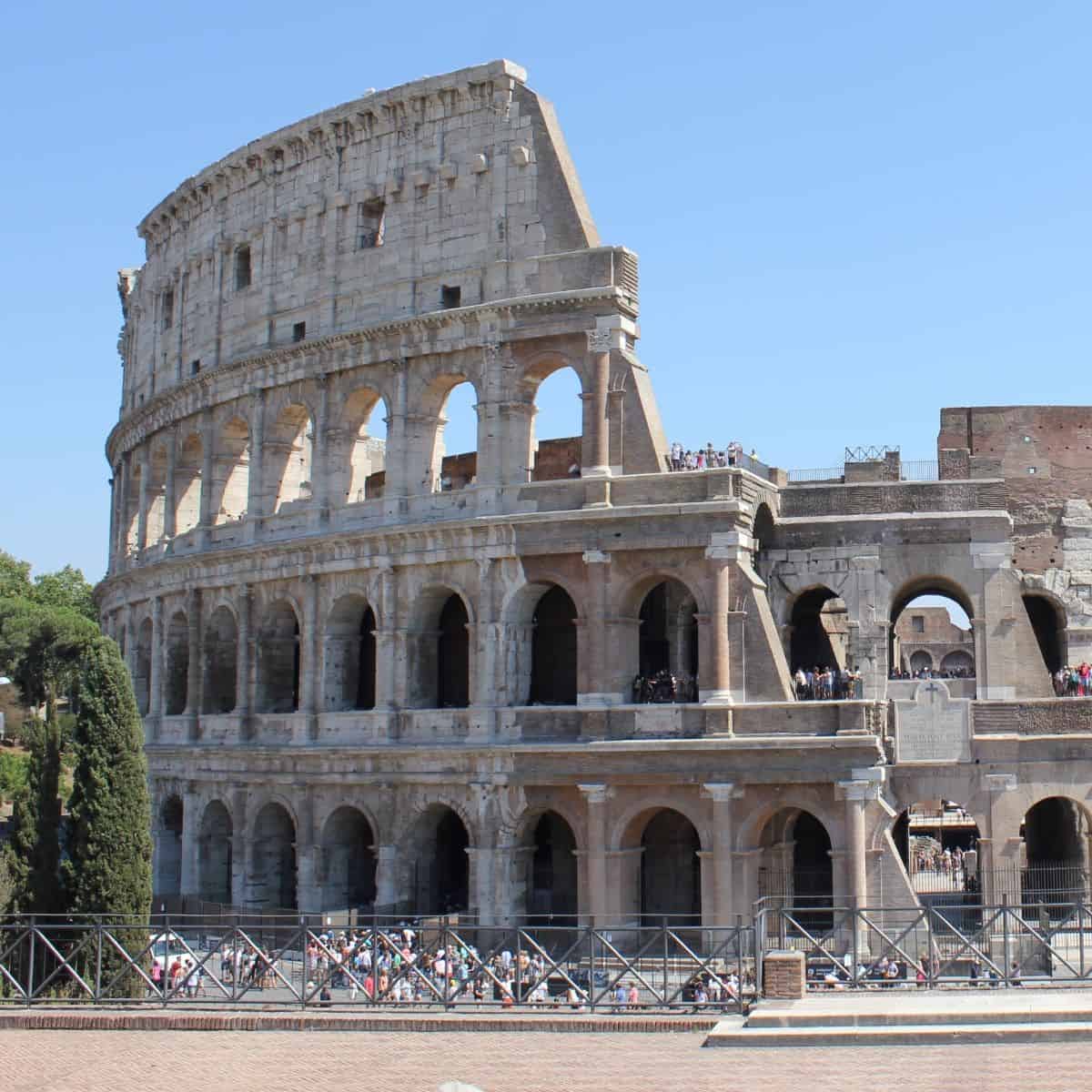
The Colosseum is the largest amphitheater ever built in the Roman world. It’s one of the defining monuments of ancient Rome.
Built almost 2,000 years ago, it could hold tens of thousands of spectators. They came to watch gladiatorial contests, wild-animal hunts, and other public spectacles. Its architecture was designed to handle enormous crowds. At the same time, it created a dramatic setting for entertainment on an unprecedented scale.
Today, a visit takes you through the surviving levels of the amphitheater. Depending on your ticket, you can see the arena, underground structures, museum, and upper areas.
Planning your visit in advance matters here more than at most Rome attractions. Entry is timed, and different tickets unlock different parts of the monument.
Plan Your Visit to the Colosseum
| Address | Piazza del Colosseo, Rome |
| Opening hours | From 8:30 AM; closing time varies by season |
| Closed | December 25 and January 1 |
| Standard ticket | €18 |
| Full Experience ticket | €24 |
| Time inside the Colosseum | 75–90 minutes, depending on ticket |
| Roman Forum and Palatine Hill | Included with the standard ticket |
| Nearest Metro | Colosseo, Metro B |
| Booking | Timed entry to the Colosseum is required |
| Tickets released | 30 days before the visit |
| Accessibility | Accessible areas and elevators available |
| Official website | Parco archeologico del Colosseo |
Important: Tickets are issued in the visitor’s name. Bring identification that matches the name on your ticket. Official ticket sales open 30 days before the date of your visit.
Opening and closing times vary during the year, so check the official website before you go.
Why Visit the Colosseum?
The Colosseum lets you experience Roman history through the architecture of a building designed for enormous public spectacles.
Its scale is part of the experience. The amphitheater had to move tens of thousands of spectators efficiently through entrances, corridors, stairways, and seating areas — a logistical achievement that still shapes how modern stadiums are designed.
The organization of the spectators reflected Roman society itself. Seating was assigned by social status. The arena below was the setting for spectacles staged by Rome’s political elite, often at enormous personal expense — sponsoring games was one of the main ways ambitious Romans built public support.
Below the arena was another world entirely. Workers, animals, gladiators, equipment, and scenery were prepared out of sight before appearing in front of the audience, often through trapdoors that made animals seem to materialize from nowhere.
A visit isn’t only about gladiators, then. The Colosseum helps you understand Roman architecture, engineering, entertainment, social hierarchy, and political power all at once.
I particularly recommend visiting if:
- You want to understand how Roman public entertainment worked.
- You’re interested in gladiators and ancient spectacles.
- You want to see Roman engineering and architecture on a monumental scale.
- You’re interested in the relationship between entertainment, society, and political power in ancient Rome.
- You want to explore one of the most important surviving monuments of the Roman Empire.
The Colosseum is familiar from photographs, movies, and popular culture. Being inside it gives you a very different perspective. It stops being an image of Rome and becomes a building — one you can walk through, look up at, and stand inside.
What Will You See at the Colosseum?
What you see depends partly on the ticket you buy.
The standard ticket covers the first and second levels of the Colosseum, plus the Colosseum Museum. Other tickets add areas like the arena floor, underground levels, or attic.
It’s worth understanding these differences before you buy.
The First Level
Once inside, you start to understand how the amphitheater was organized.
The surviving corridors, arches, stairways, and seating areas show how the building handled large numbers of spectators moving in and out.
The seating wasn’t random. Roman society was mapped directly onto where people sat. The emperor and senators occupied privileged positions close to the arena. Other social groups were assigned different sections, with lower-status spectators seated higher up — the higher you sat, the lower your standing.
Look at the architecture, not just toward the arena. The building itself is as much a part of what you’ve come to see as the events it once hosted.
The Second Level and Panoramic Terraces
The standard ticket also includes the second level and its panoramic terraces.
From higher up, you get a clearer sense of the amphitheater’s overall shape. You can look down toward the arena and underground structures, and across the surviving seating areas.
This elevated vantage point makes it easier to see how the different parts of the building fit together — something that’s hard to grasp from ground level alone.
The Arena
The arena was the stage of the Colosseum. Gladiatorial contests, animal hunts, and other spectacles played out here in front of the crowd.
Most of the original arena floor no longer survives, which is why you can now look down into the underground structures that were once hidden beneath it.
Part of the floor has been reconstructed, letting visitors with the right ticket walk onto the arena level itself.
Standing on the arena gives you the perspective of the performers who once entered the space — not the spectators looking down from above. It’s a genuinely different way of experiencing the monument.
Arena access isn’t included in the standard ticket.
The Underground Levels
The underground area, often called the hypogeum, was the working area beneath the arena.
Today you can see a network of corridors and structures that once sat below the wooden arena floor. Animals, people, scenery, and equipment were prepared here before appearing above. Trapdoors, hoists, and winches moved people, animals, and equipment into the performance space — some elevators could lift a caged animal from the hypogeum directly into the arena in one motion.
The surviving underground area covers roughly half a hectare, organized around a central passage with multiple side corridors.
This is one of the most interesting areas for understanding the technology and organization behind the spectacles — closer to a working backstage than a monument.
Access requires the Full Experience ticket.
The Colosseum Museum
The Colosseum also contains a museum, which explains the amphitheater’s history, architecture, and the spectacles and people associated with it.
It’s included with the standard ticket.
Give the exhibits some real time rather than treating the museum as a corridor to pass through. The context they provide makes the architecture around you easier to read once you’re back outside.
The Attic
The attic offers a high-level perspective over the whole amphitheater.
These upper areas were historically associated with spectators lower in the Roman social hierarchy — the cheapest, farthest seats. Today, the height gives you wide views across the interior and the surrounding archaeological landscape.
Access to the attic requires the Full Experience ticket.
A Short History of the Colosseum
The ancient name of the Colosseum is the Flavian Amphitheater.
It was built in the first century AD under the Flavian emperors. Construction began under Emperor Vespasian. His son Titus inaugurated the amphitheater in AD 80, reportedly with 100 days of games. Further work followed under Domitian.
For centuries, it hosted public spectacles. Gladiatorial combat is what people associate with the Colosseum today, but the program also included wild-animal hunts and other forms of entertainment — some accounts describe the arena floor being flooded for staged naval battles in its earliest years, before the underground structures were built.
The underground structures evolved as the spectacles became more elaborate. Machinery let animals, people, and scenery move from below the arena into full view of the spectators above.
The Colosseum’s history didn’t end with the ancient spectacles.
Over the centuries, parts of the building were reused for different purposes, and stone was stripped from it for other construction projects around Rome. Earthquakes, reuse, and time all contributed to the incomplete structure you see today.
So the monument isn’t frozen at one moment in Roman history. It’s been built, modified, damaged, reused, excavated, restored, and preserved across nearly two thousand years.
How Long Should You Spend at the Colosseum?
Plan on 75–90 minutes inside the Colosseum, depending on your ticket.
The standard ticket allows a 75-minute visit. Some Full Experience tickets allow 90 minutes.
Your overall archaeological visit can run much longer, since Colosseum tickets also grant access to the Roman Forum and Palatine Hill under the conditions of your specific ticket.
If you plan to explore those areas too, allow several hours rather than building your day only around the Colosseum entry time.
Keep seasonal closing times in mind if you’re considering a late-afternoon reservation. You’ll want enough daylight and time for everything on your list.
Colosseum Opening Hours
The Colosseum opens at 8:30 AM. Closing times change during the year:
- March 29–September 30: 8:30 AM–7:15 PM; last admission at 6:15 PM
- October 1–24: closes at 6:30 PM; last admission at 5:30 PM
- October 25–February 28: closes at 4:30 PM; last admission at 3:30 PM
The Roman Forum-Palatine area opens at 9:00 AM.
The archaeological park is closed on December 25 and January 1.
Special openings and schedule changes can happen, so check the official timetable shortly before your visit.
Colosseum Tickets: Which One Should You Buy?
Choosing your ticket is one of the most important parts of planning your visit.
The main decision: do you want the standard route, or access to a special area like the arena, underground levels, or attic?
Standard Colosseum, Roman Forum and Palatine Ticket — €18
This ticket includes:
- First level of the Colosseum
- Second level and panoramic terraces
- Colosseum Museum
- Roman Forum
- Roman Forum Museum
- Palatine Hill
- Current exhibitions
The ticket is valid for 24 hours. It gives you one timed entry to the Colosseum and one entry to the Roman Forum-Palatine archaeological area.
It does not include the arena or underground levels.
For visitors who want to see the amphitheater’s principal areas, this is a substantial visit on its own.
Full Experience Arena — €24
Valid for two consecutive days. It adds arena access and a 90-minute visit inside the Colosseum.
Choose this if standing on the arena floor matters to you.
Full Experience Underground and Arena — €24
Includes the underground levels and arena, plus access to the Roman Forum, Palatine Hill, and additional sites within the archaeological park.
The underground route is especially useful if you want to understand the technical machinery behind the spectacles.
Access to the underground levels is controlled and requires this specific ticket and route.
Full Experience Attic — €24
Also valid for two consecutive days. Includes the regular Colosseum route plus the intermediate gallery, third level, attic, and panoramic lift, along with the Roman Forum-Palatine area and additional included sites.
Consider this option if the upper architecture and panoramic views matter most to you.
Only Arena — €18
A shorter visit focused on the arena itself, rather than the standard route through the first and second levels. It also includes access to the Roman Forum-Palatine area under the ticket’s conditions.
Read carefully what this ticket includes before buying — the route through the Colosseum is different from the standard visit.
Do You Need to Book the Colosseum in Advance?
Yes. You need a reserved time slot to enter.
Official ticket sales open 30 days before your visit date.
Your entry time matters — you can’t simply show up at a different time and expect your ticket to still be valid.
Tickets are issued in the visitor’s name, so bring identification that matches.
If you want to visit the underground levels, arena, or attic, decide before buying, since these areas require specific ticket types.
For current ticket options and booking, use the official Parco archeologico del Colosseo ticketing service.
What Should You Know Before Entering?
Don’t plan to arrive at the last minute. You have a timed reservation, and you’ll still need to get through entrance and security procedures.
Keep your ticket and identification on hand.
Wear comfortable shoes — there are stairs and uneven archaeological surfaces, and the overall visit involves a fair amount of walking.
Weather matters too. Parts of the visit are exposed to the elements, and much of the wider archaeological area is outdoors.
In hot weather, bring water and sun protection, and factor the time of day into which entry slot you choose.
Is the Colosseum Accessible?
The Colosseum provides accessible areas, restrooms, and elevators or lifting equipment.
That said, this is an ancient monument with multiple levels, stairs, archaeological surfaces, and ticket-specific routes. Accessibility can vary depending on which area you want to visit.
If you have specific mobility or accessibility requirements, check current accessibility information for your intended route before buying a specialized ticket.
How to Get to the Colosseum
The Colosseum sits at Piazza del Colosseo in central Rome.
From Stazione Termini
The simplest route is by Metro. Take Metro Line B toward Laurentina from Termini and get off at Colosseo.
The journey takes just a few minutes. When you exit Colosseo station, the monument is directly in front of you.
From Piazza Venezia
The easiest way here is on foot. Walk along Via dei Fori Imperiali toward the Colosseum.
The walk takes you through the archaeological heart of Rome, with the Imperial Fora alongside you and the Colosseum ahead. Allow around 15–20 minutes, depending on your pace.
Planning the Colosseum, Roman Forum and Palatine Hill
Your Colosseum ticket can also include access to the Roman Forum and Palatine Hill, so plan your day around the wider archaeological visit, not just the Colosseum itself.
These are distinct archaeological areas with their own histories and monuments.
The Roman Forum was a major center of political, religious, judicial, and ceremonial life in ancient Rome.
Palatine Hill is tied to Rome’s earliest traditions and later became the site of imperial residences.
You don’t have to rush from one area to the next. Your ticket’s validity period depends on which one you bought — some Full Experience tickets are valid for two consecutive days, which gives you room to split the visit.
Check your ticket conditions and plan your time accordingly.
Is the Colosseum Worth Visiting?
Yes.
Its importance goes well beyond gladiators. The building brings together architecture, engineering, entertainment, social hierarchy, and imperial power in one structure. Its surviving remains let you see how an enormous Roman amphitheater was organized — how spectators, performers, animals, and machinery each occupied a different part of the same building.
Look at the entrances and corridors. Look at the seating levels. Look down into the underground structures. Think about the movement of tens of thousands of spectators, and the work happening behind the scenes to produce the spectacles they came to see.
That’s where the Colosseum stops being just an iconic photo opportunity.
It becomes a way to understand how ancient Rome actually worked.
Last Updated on August 26, 2026 by Kim Renberg