
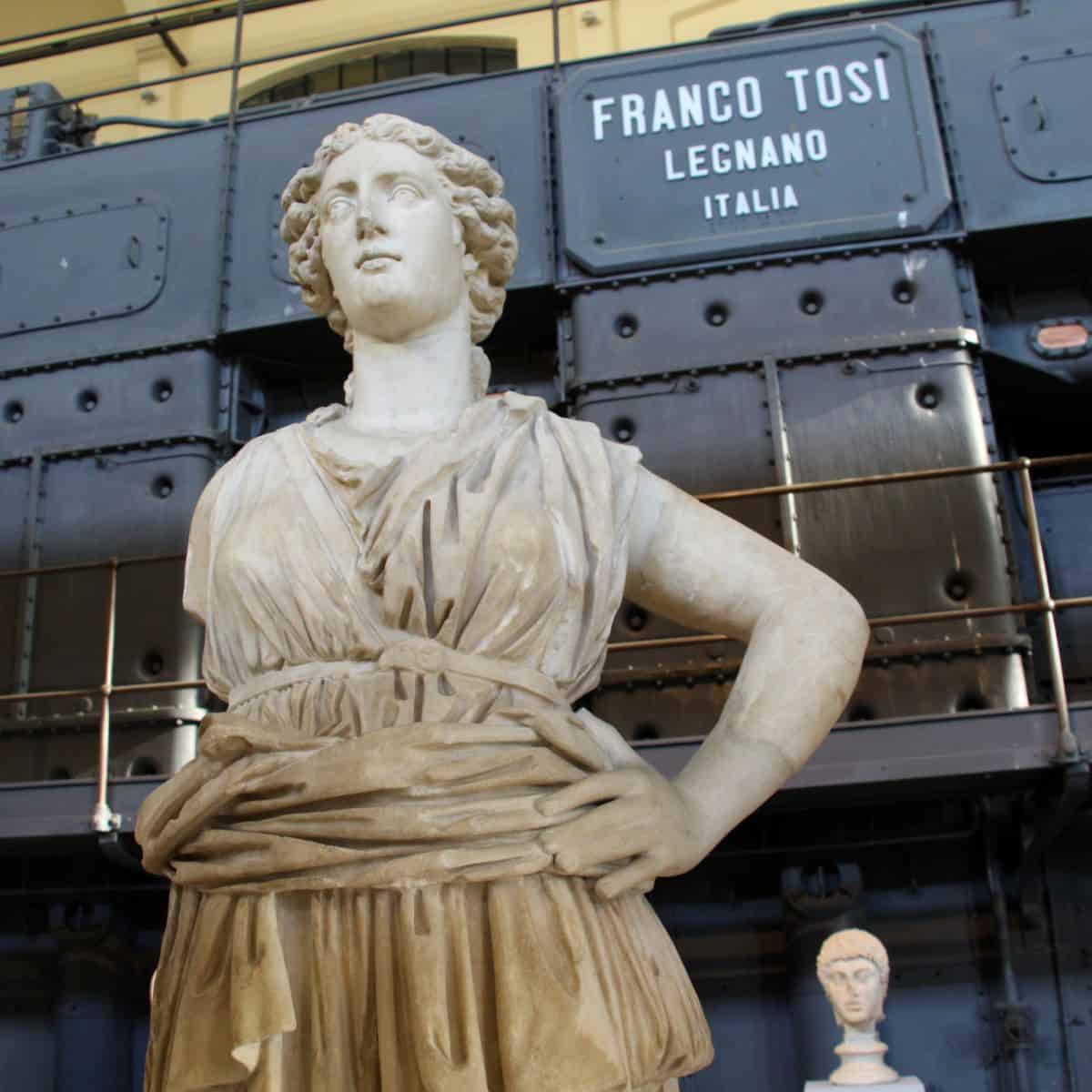
Centrale Montemartini is one of Rome’s most unusual museums. Ancient Roman statues, mosaics, and archaeological finds stand among the turbines, boilers, and machinery of Rome’s first public power station. White marble beside cast iron. Classical gods next to industrial engines. It’s a combination you won’t find anywhere else in the city.
If you’re planning a visit to Centrale Montemartini, here’s what to expect, what not to miss, and how to get there.
Located on Via Ostiense, south of Rome’s historic center, it’s a good choice if you want to see ancient Roman art away from the crowds — or simply discover a different side of the city.
Plan Your Visit to Centrale Montemartini
| Address | Via Ostiense 106, 00154 Rome |
| Opening hours | Tuesday–Sunday, 9:00 AM–7:00 PM |
| Closed | Monday |
| Last admission | 6:00 PM |
| Tickets | €11 standard admission |
| Time to allow | 1–2 hours |
| Nearest Metro | Garbatella, Metro Line B |
| Booking | Usually not necessary for individual visitors |
| Accessibility | Fully accessible |
| Official website | Centrale Montemartini |
Rome Unlocked tip: Centrale Montemartini rarely needs the advance planning that Rome’s busiest attractions do. Keep it in mind when you want flexibility in your itinerary.
Why Visit Centrale Montemartini?
Rome has no shortage of ancient statues. What makes Centrale Montemartini worth visiting is where you see them.
The museum occupies a former thermoelectric power station built in 1912. Much of the original machinery is still inside. Around it, the Capitoline collections’ sculptures and archaeological finds are on display — creating a contrast you won’t see in any other Roman museum.
Consider visiting if:
- You’re interested in ancient Roman sculpture and archaeology.
- You like unusual museums and industrial architecture.
- You’ve already covered Rome’s major ancient sites and want something different.
- You want to explore Rome beyond the historic center.
- You prefer a compact museum over a collection that takes half a day.
- You need an indoor option for a very hot or rainy day.
At Centrale Montemartini, the building is almost as much a part of the experience as the collection itself.
What Will You See at Centrale Montemartini?
The museum holds sculptures, mosaics, funerary objects, and other archaeological finds spanning Republican through Imperial Rome. Pieces come from temples, public buildings, gardens, and private homes.
You don’t need any background in Roman art to enjoy it. Half the pleasure is just walking through the rooms and watching the ancient works play off the industrial surroundings.
The Machine Room
This is the image most people associate with Centrale Montemartini. Large industrial machines dominate the space, with ancient marble sculptures standing among them.
Don’t just look at individual pieces — look at the room as a whole, and notice how the sculptures have been positioned in relation to the machinery around them.
Roman Sculpture
Several of the museum’s best-known works come from the Capitoline collections, including the Statue of Marsyas, the Portrait of Cleopatra, the Statue of the Muse Polymnia, and the Statue of a Seated Girl.
You’ll also find monumental sculptures and decorative elements taken from important buildings and archaeological sites across ancient Rome.
Mosaics and Ancient Roman Homes
The collection isn’t limited to monumental statues. Mosaics and decorative works here tell the story of Rome’s wealthy private residences — a different angle on Roman life than the temples and emperors that dominate most first-time visits.
The Industrial Machinery
Don’t treat the machinery as just a backdrop. The turbines, boilers, engines, and pipes tell their own story: Rome’s transformation into a modern European capital in the late 19th and early 20th centuries.
That industrial history is exactly what makes Centrale Montemartini feel so different from a conventional archaeological museum.
The Train of Pope Pius IX
One of the museum’s biggest surprises has nothing to do with ancient Rome. Centrale Montemartini houses three historic railway carriages linked to Pope Pius IX, dating from 1858 — including a carriage with a papal blessing loggia, a throne room, and a chapel.
It belongs to a completely different chapter of Roman history: the final years of the Papal States and the arrival of the railway age. Worth seeing even if you came purely for the Roman archaeology.
From Power Station to Museum
The building opened in 1912 as Rome’s first public electricity-generating plant, under Mayor Ernesto Nathan. It was later named after Giovanni Montemartini, a member of Nathan’s administration.
Its second life began in 1997, when renovations at the Capitoline Museums forced part of their ancient sculpture collection to move. The former power station provided the space. What was meant as a temporary exhibition worked so well that the pairing became permanent.
Today, visiting Centrale Montemartini means seeing two eras of Rome side by side: the ancient city in the sculptures, and the modern city in the power station that once helped electrify it.
How Long Should You Spend at Centrale Montemartini?
Plan on 1–2 hours for a typical visit. That’s enough time to see the main rooms and highlights without turning it into an all-day museum trip.
Allow more time if you have a particular interest in Roman sculpture, industrial history, or if there’s a temporary exhibition running.
Its manageable size is one of its biggest advantages — you get a substantial museum experience without giving up most of your day.
Centrale Montemartini Opening Hours
- Tuesday–Sunday: 9:00 AM–7:00 PM
- Last admission: 6:00 PM
- Monday: Closed
Hours can change around public holidays. If you’re making a special trip to Via Ostiense just for the museum, check the official website before you leave.
Centrale Montemartini Tickets
Standard admission is €11, with a reduced ticket of €6.50 for eligible visitors. An additional €1 presale fee applies to advance purchases, and temporary exhibitions can affect pricing.
Since February 2026, residents of Rome and the Metropolitan City of Rome can enter for free with a valid ID. MIC Card holders also get free admission. The museum is included in the Roma Pass.
Prices and conditions can change, so check the official museum information before visiting.
Do You Need to Book in Advance?
Usually, no. For individual visitors, Centrale Montemartini isn’t one of those Rome attractions that requires you to organize your day around a hard-to-get time slot.
You can buy tickets at the museum, subject to availability, or purchase online in advance. Groups have separate reservation requirements. If you’re visiting for a special exhibition or event, check current conditions beforehand.
Is Centrale Montemartini Accessible?
Yes. The exhibition spaces are accessible across all levels, with elevators serving the upper floors. A wheelchair is available on request, and seating is provided throughout.
The museum also offers tactile elements and audio descriptions for blind and partially sighted visitors, plus Italian Sign Language content for deaf visitors. Strollers are welcome.
Check the museum’s current accessibility information if you have specific requirements.
How to Get to Centrale Montemartini
Centrale Montemartini sits at Via Ostiense 106, south of Rome’s historic center. Since it’s outside the main cluster of central attractions, public transport usually beats walking.
By Metro: Take Metro Line B to Garbatella, then walk to Via Ostiense.
From Termini Station: Take Metro Line B toward Laurentina, get off at Garbatella, and walk from there. The full journey typically takes 20–30 minutes.
From Piazza Venezia and the historic center: Bus connections run toward Via Ostiense, though travel times vary with traffic — check the current route before leaving. A taxi is a straightforward alternative.
Walking is possible, but I wouldn’t recommend it just to get there — it’s far enough from the central archaeological area that it only makes sense if the walk itself is part of your exploration of this side of Rome.
Is Centrale Montemartini Worth Visiting?
Yes — but I wouldn’t put it ahead of the Colosseum, Roman Forum, Pantheon, or Rome’s other essential sights if you’re a first-time visitor with only a few days.
It becomes genuinely interesting once you want to move beyond the standard Rome itinerary. Come for the Roman sculpture, but pay just as much attention to the building and machinery around it — that contrast is the real reason to visit.
Its compact size is another point in its favor: you get a worthwhile museum experience without committing several hours, the way you would at Rome’s larger collections.
For visitors who’ve already seen Rome’s famous ancient sites, Centrale Montemartini offers something different: ancient Rome, displayed inside the story of modern Rome.
Last Updated on August 22, 2026 by Kim Renberg